


From the Platte Institute
By
Adam Weinberg
Someday,
you might have a conversation with a loved one too young to remember
2020. Maybe you’ll recall your online visits with the people you
missed.
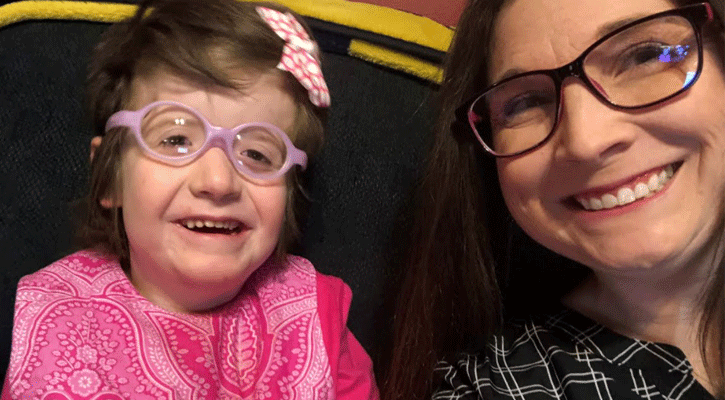
Victoria Kerber just turned five years old recently. For her, getting online during the pandemic meant learning how to one day share her own story.
Victoria has a rare chromosome disorder. She needs help from her mom, Abbie, and therapists at the Pediatric Therapy Center in Papillion, to learn tasks that many children and parents take for granted—communicating, feeding herself, and walking.
As
part of Victoria’s occupational therapy and speech-language
therapy, she uses a walker and an iPad-like communication device
called a talker.
Victoria makes a few taps on the screen,
and a child-like voice says to me, “Hi, I’m Victoria.”
Despite
being non-verbal, Abbie says Victoria is “very opinionated.”
“She is very behind on just about everything, except
attitude,” Abbie says with a laugh.
Like any
five-year-old, as Abbie and I spoke at length over Zoom about
occupational therapy, Victoria used her talker to tell her mom she’d
really like to be playing with her toys.
Tapping out this message is progress for Victoria. Before therapy, she was uncomfortable touching objects.
“She
wouldn’t even hold a spoon, which at her age, you would think would
be a very typical thing,” Abbie said.
“But we struggle
and we work hard, and the therapists have been amazing,” Abbie
said.
The pandemic made continuing Victoria’s therapy at the Center a challenge. In June, Victoria had an urgent skull surgery. Abbie wondered how Victoria could safely continue therapy without falling behind.
Victoria
can’t wear a facemask for medical reasons, and the rarity of her
condition makes COVID-19 an even more uncertain risk.
“Because
of her specific [chromosomal] deletion, we really didn’t know how
her body would react, and she’s non-verbal, so she couldn’t say
‘I can’t breathe,’” Abbie said.
As COVID-19 cases increased, a better trend was also happening across Nebraska. More patients turned to telehealth for facetime, or a phone call, with physicians, therapists, and others practitioners.
An emergency executive order had expanded access to telehealth in Nebraska, waiving restrictions on patient location, and helping new patients receive initial consultations virtually, even if they hadn’t been in a clinic before.
Abbie was skeptical about using telehealth for Victoria’s therapy. She had previously struggled to keep Victoria engaged with therapy at home.
But
after seeing the therapists help Victoria to sharpen her skills
virtually in her home environment, she became a believer.
“She
made so many strides over that summer. When she would see the
therapist on the other side of the screen, it was like she realized
“Oh, hey, I have to work,’” Abbie said.
“I was
very, very grateful for telehealth, because I could still have her
sessions at home and not risk having a very newly operated-on child
out in public,” Abbie said.
In Lincoln, policymakers are
recognizing that the emergency expansion of telehealth in the state
has been a lifeline for Nebraskans like Victoria. Sen. John Arch’s
Legislative Bill 400, which already won unanimous first-round
approval in the Legislature, would make several of the emergency
waivers permanent.
LB400 lifts patient location restrictions, meaning telehealth appointments can be taken from home, work, or school. The definition of telehealth would be expanded to include audio-only calls for individual behavioral health appointments, which helps patients who may not have broadband to speak with a therapist.
LB400 also removes a paperwork barrier. Instead of needing a consent form signed before the appointment, a digital signature could be provided within ten days.
After seeing the results for Victoria, Abbie thinks the bill will encourage more patients, particularly in occupational therapy, to get the care they and their children need.
“Having telehealth is a whole lot better than not having anything, and because of telehealth, Victoria didn’t have that learning loss after her surgery,” Abbie said.
“So
many kids feel more comfortable in their own environment, or may not
be able to leave their environment, and they could all benefit from
having a real therapist on their screen, ready to help them,” Abbie
said.
Adam
Weinberg is Communications and Outreach Director at the Platte
Institute.