


By Tena L Cook, Marketing Coordinator, CSC
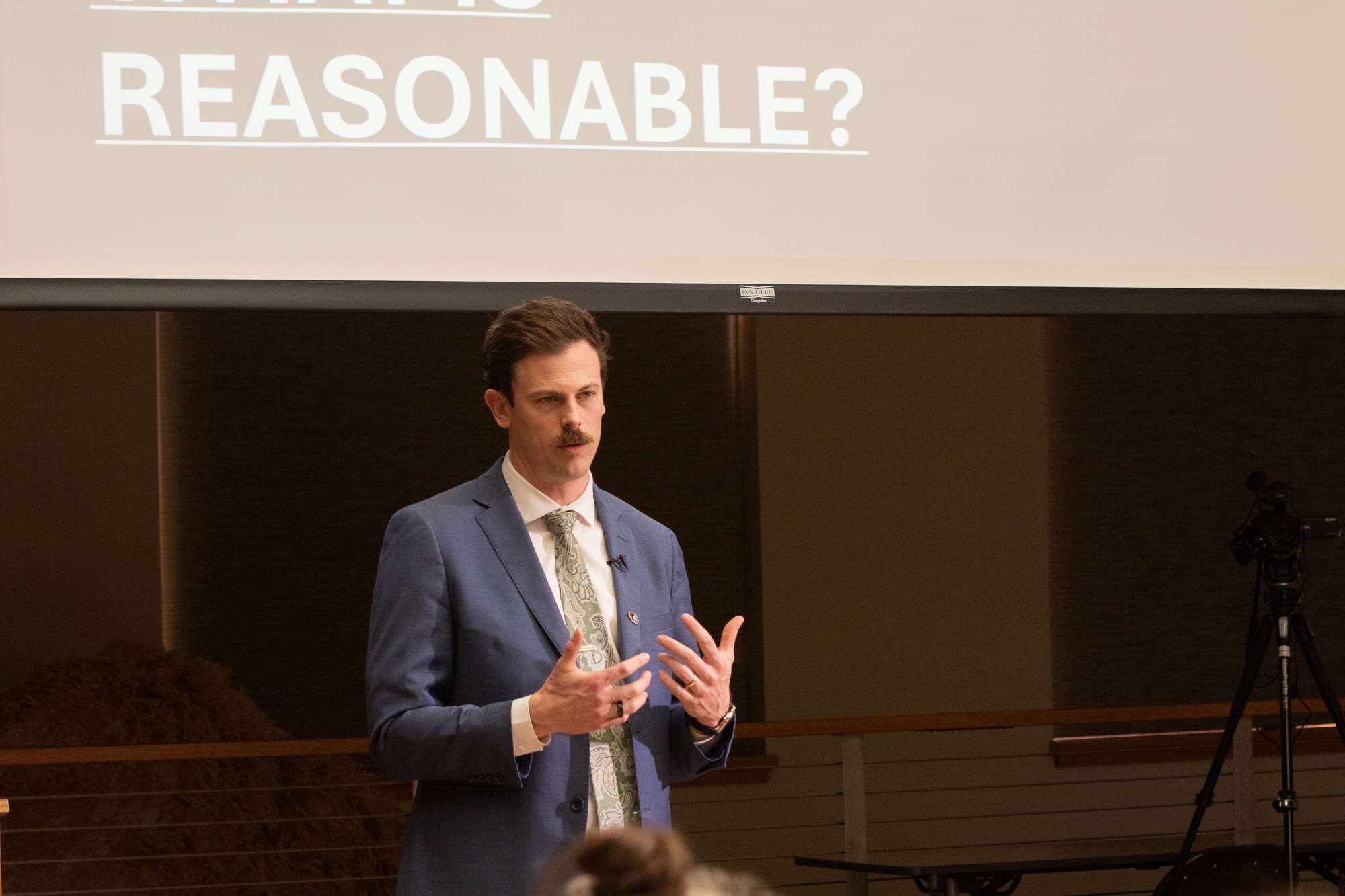
CHADRON, Neb. – Chadron State College alumnus Conor Casey discussed the principle of reasonableness during his March 19 Graves Lecture, titled Who Decides What’s Reasonable?
Casey, a trial attorney in Rapid City, South Dakota, works for Beardsley, Jensen & Lee.
“Helping where others will not is a hallmark pillar of what we do,” he said.
Casey’s family founded the tourist attraction Bear Country south of Rapid City. Following high school, he played football at Chadron State College and earned a bachelor’s degree in English and philosophy in 2015. As a graduate student, he worked in College Relations and earned an MBA in 2018. He later attended law school in Vermillion, South Dakota.
Casey, who serves on the South Dakota Trial Lawyers Association Board of Governors, handles federal tort claims, civil rights cases and matters involving sovereign immunity and treaty rights.
“If I feel like it’s something I can help with, and my firm allows me to do that, I take the case,” he said. “It’s still a very important right we have as citizens to a trial when you’re accused of something criminal or when you’ve been wronged.”
Casey said the concept of reasonableness is rooted in constitutional protections and serves as a flexible legal framework.
“Reasonableness in the law is a living, breathing tool,” he said. “It’s a framework, and while powerful, it’s flawed in some ways.”
He emphasized the role of juries in the U.S. legal system.
“We’re the only place in the world where you have a constitutional right to be judged by your community,” Casey said. “Who decides what’s fair? You do.”
To illustrate, Casey described a scenario in which a driver runs a four-way stop near campus and causes an accident.
“If that person is injured, you’re at fault,” he said. “But what if you ran the stop sign because your pregnant wife was in labor and it felt like an emergency?”
He said such situations demonstrate how context shapes legal outcomes.
“The question is, what would an ordinary, careful person do in a similar situation?” Casey said.
He also referenced two landmark cases: Palsgraf v. Long Island Railroad Co., which helped define negligence and liability, and Katz v. United States, which established that the Fourth Amendment protects reasonable expectations of privacy.
“The Constitution starts with three words, ‘We the people,’” Casey said. “As a jury member, you’re making law in that moment. You matter.”
Casey shared examples from his firm’s cases, including one involving a concertgoer who suffered a head injury after another attendee jumped from the stage. In another case, the firm successfully defended a landowner in a slip-and-fall lawsuit involving alleged ice on a sidewalk.
Casey concluded by encouraging audience members to value their role in the judicial system.
“Who decides what’s reasonable? You do,” he said. “A jury trial and the reasonableness standard allow everyday people to make decisions about complex situations. It’s designed to find common ground. Use it wisely.”
The final Graves Lecture of the Spring Semester will be Art Professor Mary Donahue speaking about her experiences leading students on art trips. It will be at 6 p.m. in the Sandoz Center.