


By Tena L Cook, Marketing Coordinator, CSC
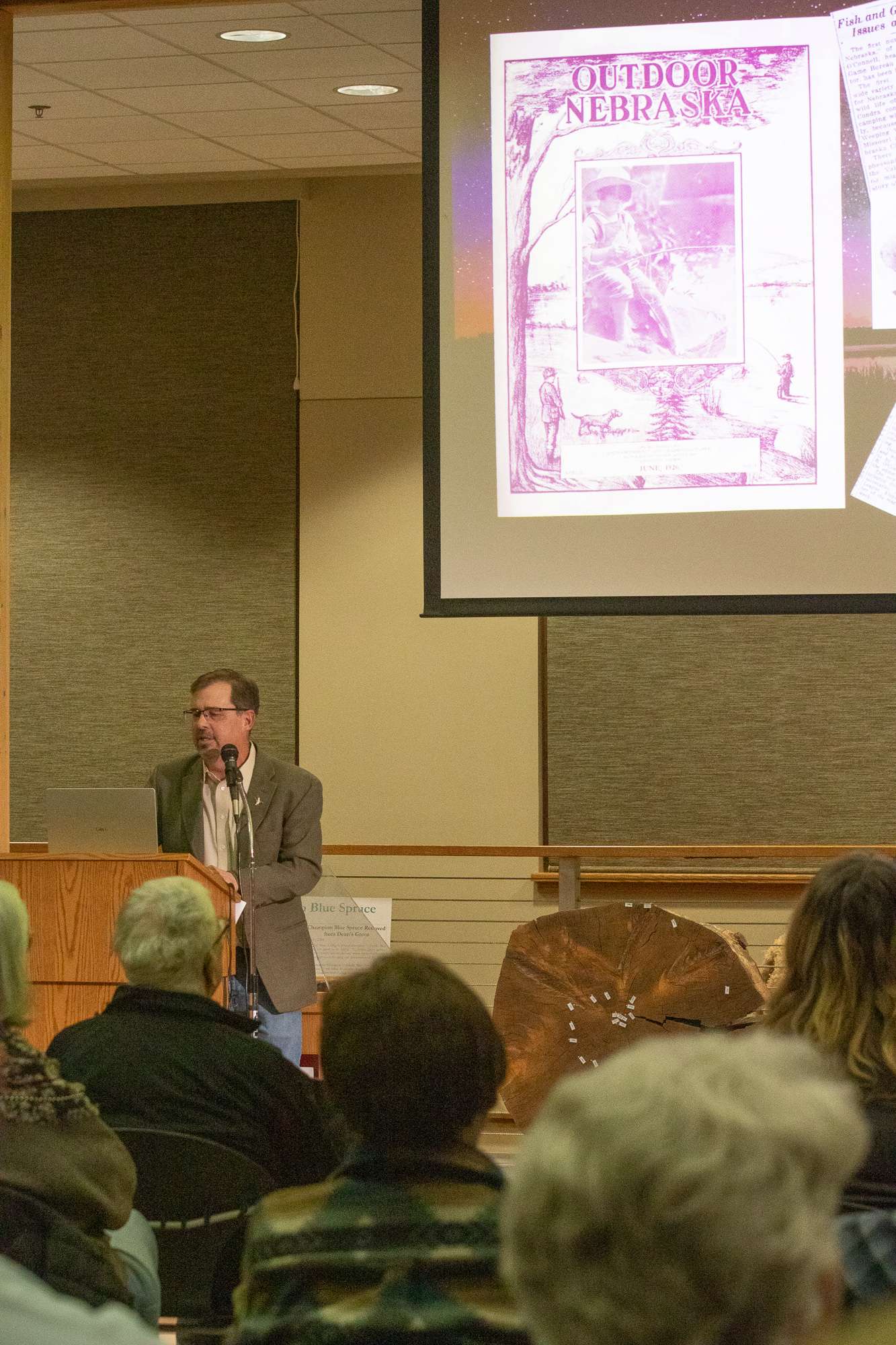
CHADRON, Neb. – In the first Graves Lecture of the spring semester, CSC alum and Nebraskaland Regional Editor Justin Haag spoke about the magazine’s 100th anniversary celebration.
He included a brief history of the natural conservation movement. In the late 1800s and early 1900s, the United States experienced rapid growth that came at a steep environmental cost. Haag said an estimated 940 million acres of virgin forest were lost by 1850. White-tailed deer populations plummeted from roughly 30 million to just 300,000 by 1900. Canada geese neared extinction, and the American bison once numbering in the millions fell to fewer than 100 by 1902.
The conservation movement emerged in response to those losses. Naturalist John Muir, who guided President Roosevelt through what would become Yosemite National Park, said, “In every walk with nature, one receives far more than he seeks.”
Haag said those words still resonate with him when he heads into the field with his camera.
Nebraskaland magazine launched in June 1926 as Outdoor Nebraska. Chadron State Park was five years old, and Haag said early issues of the quarterly publication repeatedly promoted the park to readers in eastern Nebraska, most who had never seen the Pine Ridge’s buttes and forests. The first issue was 16 pages and featured a cover image of a young person fishing.
The magazine was founded by Frank B. O’Connell, who later became director of the state agency now known as the Nebraska Game and Parks Commission. Haag said in the inaugural issue, O’Connell wrote, “The people of the Middle West are just now awakening to the fact that unless something is done and done quickly, the wildlife and natural beauty of this prairie will have vanished before the ever-grasping hand of commerce.”
From its earliest days, the magazine championed public lands, fish and wildlife. Haag said copies were distributed to members of the Isaac Walton League, a prominent conservation group whose projects included developing Walgren Lake between Hay Springs and Rushville. Early editions featured fish stocking reports, photos of anglers with their catches and assertive conservation messages.
In 1949, artist C.G. Bud Pritchard joined the staff, remaining until 1974. Before the era of large zoom lenses and a supply of wildlife photographs, Pritchard created detailed illustrations to accompany natural history stories. He often drew and painted animals from memory, producing covers that remain popular today, Haag said. Some of the vintage Pritchard covers are being reissued as prints to celebrate the magazine’s 100th anniversary.
The publication became monthly in 1958. Six years later, under Gov. Frank Morrison, the magazine changed its name to Nebraskaland and expanded to 60 pages as the agency assumed responsibility for tourism.
As photography replaced illustrations, landmarks such as Toadstool Geologic Park have appeared regularly in the publication.
“It’s a photographer’s wonderland,” Haag said of Toadstool Park.
Haag’s path to Nebraskaland was influenced by a presentation at CSC by conservation photographer Michael Forsberg. Haag was struck by Forsberg’s use of imagery to deliver a conservation message and later wrote a story about him. He credits his colleague and fellow CSC graduate Eric Fowler as a mentor who helped shape his career.
Photographing wildlife from a blind is Haag’s favorite assignment. Whether waiting on a lek for grouse, near a pond for waterfowl, or in grasslands for swift fox, Haag said he prefers to let animals come to him. He recently added a floating blind that allows him to stand in it and move quietly in shallow water.
During his presentation, he shared images he’s taken of osprey, northern shovelers, bighorn sheep, Blanding’s turtles, willets, swift foxes and rattlesnakes. One of his earliest milestones was seeing his first landscape photo published in the magazine. Since then, he said he has chased foggy Sandhills sunrises, northern lights over the Badlands in Sioux County, and lightning storms near Crescent Lake. Each moment, he said, is a reminder of the privilege of living in western Nebraska.
“I’m very fortunate to live in a great place to do this sort of thing. The best way to get good pictures of wildlife is to be there early or late,” he said.
His family has occasionally shared the spotlight. A photo of his son, Sawyer, once appeared on the magazine cover and on the agency’s website for fishing license sales. His daughter, Kiera, has also been featured and accompanied him on assignments, including a hot air balloon ride to photograph a rally.
Haag’s work includes documenting conservation operations such as tagging wildlife for tracking and he writes about topics ranging from the history of the Cheyenne Breakout at Fort Robinson to disc golf leagues. For one project in the Soldier Creek Wilderness Area, he rode mules with his colleagues into terrain where vehicles are prohibited.
Technology has expanded his toolkit. Haag has taken aerial photos from airplanes and assisted with mule deer surveys from helicopters. He is one of three commercially licensed drone pilots in the agency’s communications division, capturing images and video of locations such as Saddle Rock at Fort Robinson.
Still, some of his most complex images come from the ground. Haag uses camera traps equipped with motion sensors and multiple flash units to photograph nocturnal wildlife. He describes the setup as a studio in the field, requiring patience and precision.
As Nebraskaland celebrates its centennial year, Haag reflected on the magazine’s enduring mission.
“I often count my blessings each time I get to point my camera at our wildlife and scenery with thanks to those who have worked to keep them around,” Haag said.