


By Chabella Guzman, PREEC Communications
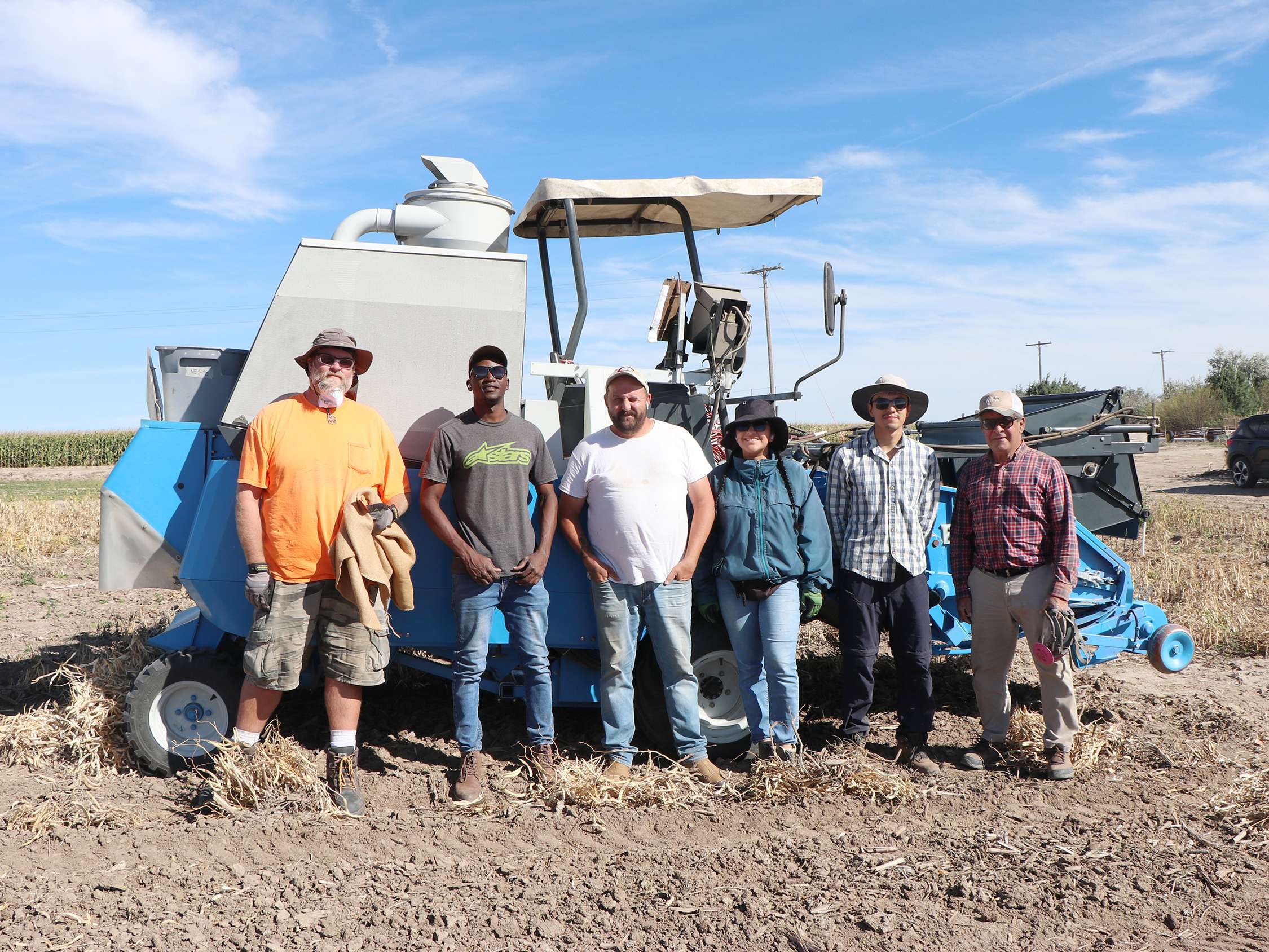
Some of the next generation of dry bean breeders and industry specialists are training at Carlos Urrea’s Dry Bean Breeding Lab. Urrea is the University of Nebraska-Lincoln Panhandle Research Extension and Education Center Dry Bean Breeder in Scottsbluff. In the past several years, he has had students and visiting scholars from various countries study with him.
“The students are exposed to all dry bean breeding activities and can apply some of the theory learned in their classes. The students are also helping me take notes, harvesting and preparing seeds for winter nurseries,” Urrea said.
In 2025, three students from three different countries joined Urrea and his crew in the fields and lab in Nebraska. Esau Higenyi is a Ugandan student pursuing his undergraduate studies at EARTH University in Costa Rica. Joel Guananga, from Quito, the capital city of Ecuador, is studying Agronomic Engineering in Costa Rica. And Valeska Fuentes-Sepúlveda, from Chile, is a fifth-year agricultural engineering student at the University of Concepción.
The students assisted Urrea in the summer and fall, during which they learned about bean diseases and varieties, and how to evaluate different phenotypes in field plots.
“My internship was very exciting because the experience was incredible. I learned about the augmented block design, the legal procedures for sending seed to another country, the methods of harvest, and the discipline and organization that the team must maintain to achieve great performance in the field, the laboratory, and the warehouse,” Guananga said.
Fuentes-Sepúlveda wrote her thesis on the "Effect of Terminal Drought on Cooking Time and Rehydration of Traditional Chilean Dry Bean Varieties." “I want to learn how to produce food sustainably and efficiently to meet the needs of the world's population. I am very grateful for the opportunity, which makes me appreciate the great research work carried out by professionals like Dr. Carlos Urrea and his team, who work in the agricultural sector to ensure food safety, a very important aspect of agriculture around the world today.”
While the students spent most days working with Urrea, they also learned more about the surrounding communities. The students partnered with Empowering Families, a non-profit in the Nebraska Panhandle. Together, they worked on a youth conference, a youth leadership event and a Lakota Cultural Retreat.
“The students were fantastic to work with,” said Maricia Marquez, Empowering Families Program Director. “I really appreciated our partnership. The students were always professional, interested and excited to engage with the community and bring great skills and perspectives.”
The students also helped Urrea with the International Bean Improvement Cooperative (BIC) and North American Pulse Improvement Association (NAPIA) Biennial meeting in Lincoln, Neb. The students helped with registration, during the oral presentations and with the posters. Urrea made sure they were also networking with the attendees, as the meeting was international. “I didn’t have these opportunities. I want this internship program to open doors for future career plans.”
Higenyi would agree that the internship is allowing him opportunities that align with his passion for plant genetics.
“During my internship, I have gained a deep understanding of the different stages of bacterial blight in beans, especially the most critical ones. I have also learned that developing a stable bean variety requires patience and long-term commitment. This internship has not only strengthened my foundation in agricultural science but also reinforced my belief that passion, patience, and purpose are the key ingredients for meaningful research and innovation,” he said.