


By Pin-Chu Lai | Nebraska Extension Entomologist
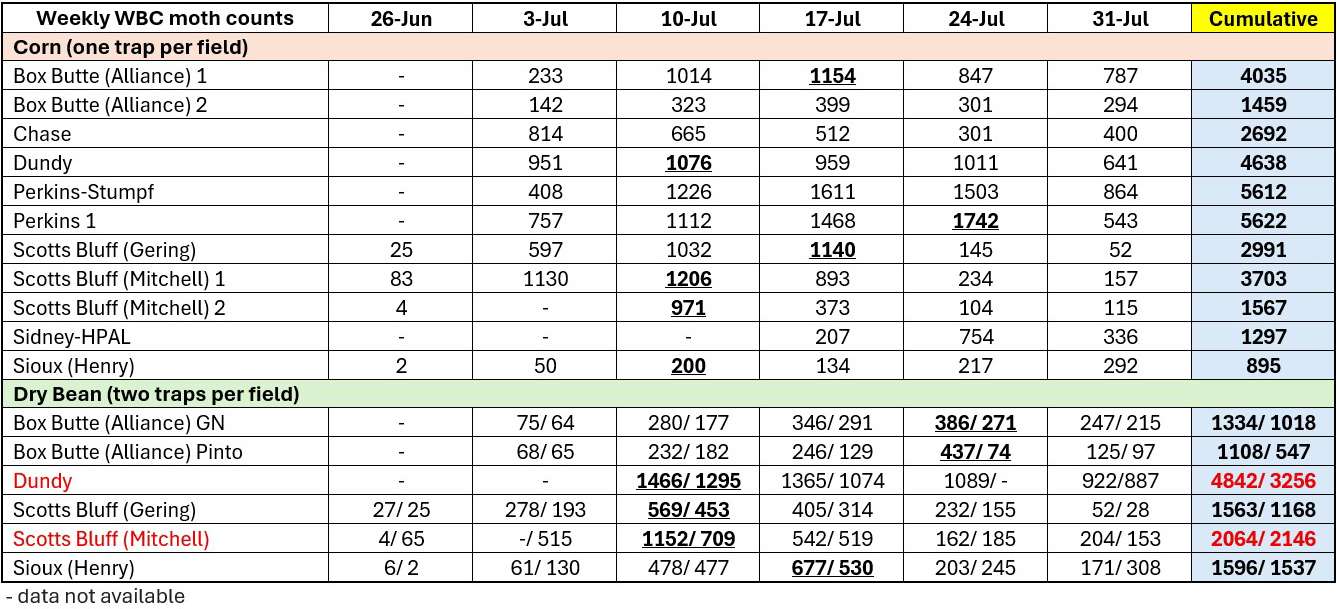
The Western bean cutworm weekly update ending July 31 shows corn at the ideal spraying stage (>95% tasseled) if exceeding the threshold of 5-8% egg masses after scouting. In dry beans, scout now in high-risk areas (>1700 cumulative moth counts); consider treatment if pod feeding exceeds 0.5-1% after scouting. The ideal treatment window is 10-21 days after flight peak.
Western bean cutworm can be a serious pest in corn and dry beans. When their populations or infestations exceed thresholds, insecticide treatment is warranted, and timely application is crucial for successful management. Moth flight data can be used to inform timing of in-field scouting and treatment. However, insecticide treatment should not solely rely on moth flight data.
For corn, a match between moth flight and the late whorl to early tassel stage of corn can result in high levels of infestation. For beans, if the cumulative moth catch at the peak moth flight (50 percent emergence) per green bucket trap is < 1200, between 1200 and 1700, and > 1700, the risk of significant damage is low, moderate, and high, respectively. Note that it is a risk assessment; actual bean damage and economic risk from larval feeding require scouting.
More information on scouting, treatment recommendations, and insecticide options: https://cropwatch.unl.edu/2020/scouting-and-treatment-recommendations-western-bean-cutworm/.
Cumulative moth catch numbers will be updated weekly. Green bucket traps are monitored by UNL PREEC Entomology Lab (Scotts Bluff and Sioux Counties), John Thomas (Nebraska Extension Educator; Box Butte County), Samantha Daniel (Nebraska Extension Educator; Chase, Dundy, Perkins Counties), and Dr. Vinicius Zuppa (Nebraska Extension Educator; Cheyenne County). Weekly trap data are compiled by UNL PREEC Entomology Lab.
###
Nebraska Extension is a Division of the Institute of Agriculture and Natural Resources at the University of Nebraska–Lincoln cooperating with the Counties and the United States Department of Agriculture. Nebraska Extension educational programs abide with the nondiscrimination policies of the University of Nebraska–Lincoln and the United States Department of Agriculture.