


By Nebraska Panhandle Research, Extension and Education Center
Part 3 of 4. Growing Crops with Limited Water in 2026
With canal delivery likely short in 2026, producers need realistic expectations for how each crop will perform under limited water. This article — Part three of a four-part Crop Watch series recapping the Yonts Water Conference — summarizes long-term deficit-irrigation research at the University of Nebraska-Lincoln (UNL), Panhandle Research, Extension and Education Center (PREEC) for corn, dry bean, sugar beet and alfalfa. Each crop responds differently, and the differences matter for 2026 planting and irrigation-scheduling decisions.
Results below are presented as relative yield, yield expressed as a percent of the maximum observed in that year’s trial, rather than absolute bushels, hundredweight, or tons. This lets us compare dry-year and wet-year responses on the same axis and focus on how much yield is lost per inch of irrigation not applied. It should be noted that although the treatments below yield responses under some extreme water-limited conditions, the research plots were under well water, which allowed flexibility in irrigation timing, especially during early crop development stages. If rainfall or canal water is scarce in the early growing season, yield loss may be greater than the figures below indicate.
Corn
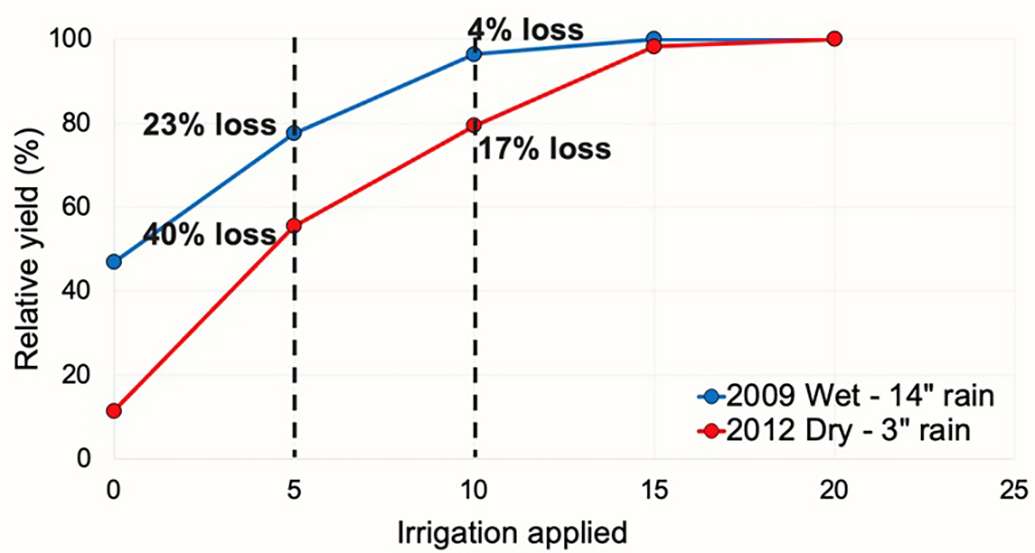
Long-term corn irrigation trials at PREEC by Dr. Gary Hergert tested five irrigation scenarios with 0, 5", 10", 15" and 20" of total available season irrigation water supply. The relative yield response under two contrasting years (wet and dry years) illustrates corn’s sensitivity to drought, so growers can get an idea of worst- and best-case scenarios. At 5 inches of irrigation, corn showed 40% yield loss in 2012 (dry year) and 23% yield loss in 2009 (wet year); at 10 inches of irrigation, the yield loss was 17% in 2012 and only 4% in 2009. As mentioned earlier, the plots were under well water, and there was flexibility in when to apply irrigation. In 2012, for example, the "5-inch" treatment received about 1 inch in the first 8 weeks, and the "10-inch" treatment received about 1.75 inches. If a grower cannot irrigate the crop during the first 8 weeks, yield loss will likely be higher than the numbers presented.
Dry Bean
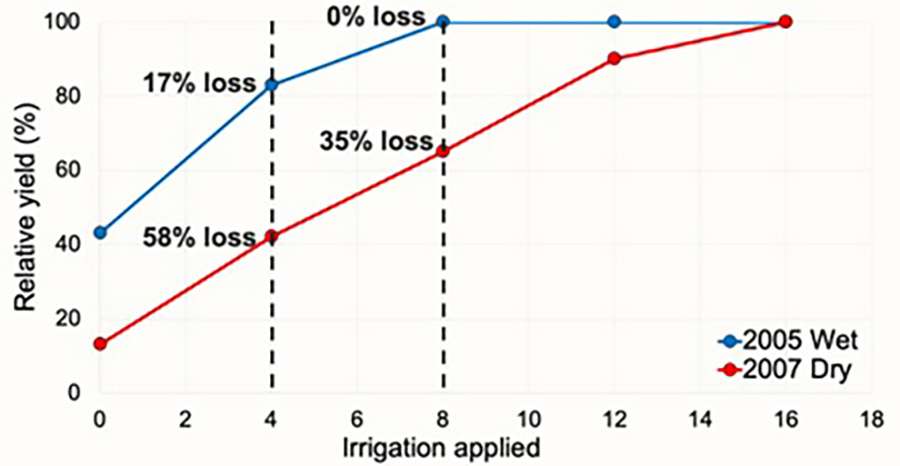
The dry bean trials used irrigation amounts of 4, 8, 12 and 16 inches. Dry beans have a lower total seasonal water requirement than corn, typically 14 to 18 inches of total crop ET. At four inches of irrigation, dry bean had 58% yield loss in 2007 (dry year) and 17% yield loss in 2005 (wet year). At eight inches of irrigation, dry bean had 35% yield loss in 2007 and 0% yield loss in 2005. Previous research (Gradiz et al., 2025) also shows that dry beans can tolerate about 25% water deficit without significant yield loss. However, beans are sensitive to excessive stress at any growth stage. Severe stress at flowering, pod fill, or during the bloom window produces disproportionately large yield losses. For example, a 25% uniform deficit is manageable; a 50% deficit concentrated at flowering is not.
Sugar Beet
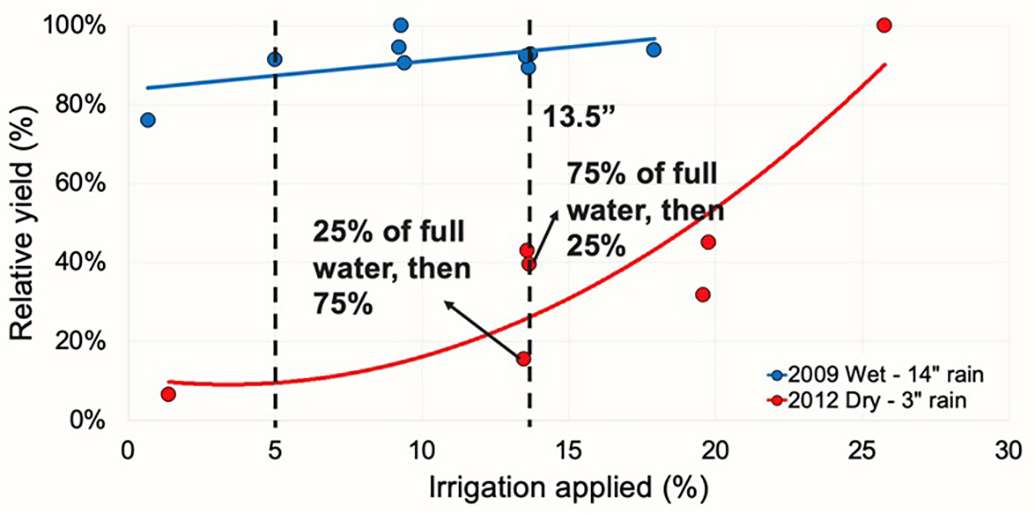
Sugar beet research at PREEC demonstrates that sugar beet behaves quite differently in wet and dry years. During wet year (2009), sugar beet is quite drought-tolerant — with only 5" of irrigation, it produced almost 90% of full yield. However, in dry year (2012), early water stress can take a big toll on yield. For example, at the same amount of 13.5" of water, irrigating sugar beets with 25% of full water in the early stage and then 75% of full water in the late stage caused more than 80% yield loss, while irrigating sugar beet with 75% in the early stage and 25% in the late stage reduced yield loss to 60%. Early-season stand establishment and canopy development are critical for sugar beet yield. The water delivery situation in 2026 makes sugar beets more susceptible to yield loss than corn or dry beans.
Alfalfa
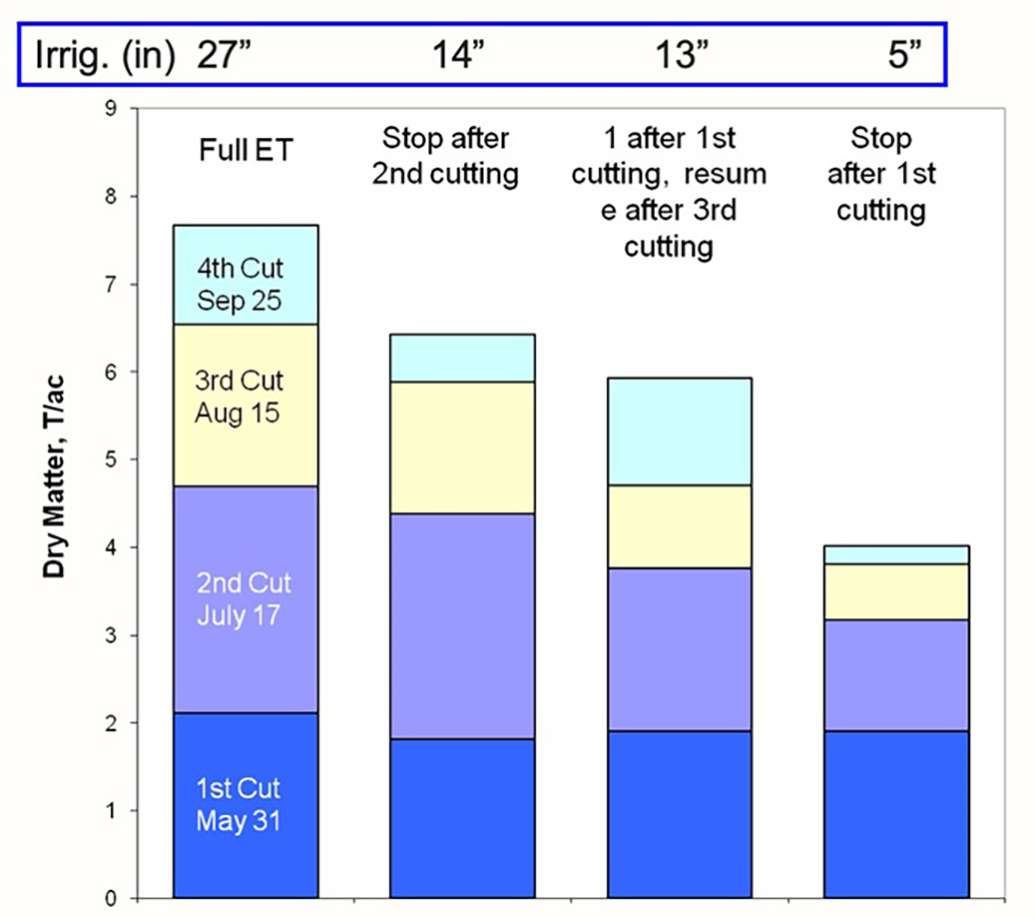
Alfalfa is usually drought-tolerant because it can enter dormancy when water is withheld and then resume growth when water returns. Data from Colorado State University (CSU) trials compared four irrigation strategies: full irrigation, stop after 1st cutting, stop after 2nd cutting and stop after 1st cutting and resume after 3rd cutting (Figure 4). According to the trial results, the best strategy for irrigating alfalfa is to stop irrigation after 2nd cutting, which only used 14" of irrigation and produced comparable yield compared to the full irrigation scenario (27"). Yet, this strategy would require early water delivery which is unlikely for producers in the Panhandle in 2026.
Putting the Four Crops Side by Side
Taken together, the research points to a clear 2026 ranking by how well each crop's water needs line up with a delayed canal delivery: sugar beet is the most exposed, because its early-season demand cannot be met in the pre-canal window; alfalfa is next, because the most water-efficient strategy (stopping irrigation after the 2nd cutting) depends on early-season water that likely won't arrive; corn is sensitive but more flexible with in-season management; and dry bean aligns best, with a June 1 or later planting date that fits the canal delivery window.
Part 4 of this series translates these research findings into specific agronomic decisions — plant population, nitrogen rates, planting date — plus the pre-canal water-budget worksheet and irrigation-system tips for furrow and center pivot.
Authors - Xin Qiao, Nebraska Extension Water Irrigation Specialist; Gary Stone, Nebraska Extension Water and Crops Educator; Saleh Taghvaeian, Jessica Groskopf, Nebraska Extension Agricultural Economics Cropping Systems Educator; Shuhua Xie, Post-Doctoral Research Associate; Joseph Oboamah, Graduate Research Assistant; Carlos Urrea, Nebraska Extension Dry Bean Breeder; Derek Heeren, Professor and Irrigation Engineer; Wei-zhen Liang, Research Assistant Professor; Abia Katimbo, Assistant Professor and Irrigation Engineer