


By John E. Weare, Keep Alliance Beautiful
ALLIANCE, Neb. - Hours before the Keep Nebraska Beautiful Conference began this past Wednesday, June 3, I found myself sitting on a rock in the shade of a linden tree on the UNL campus. A pair of squirrels (one black, the other a familiar reddish brown) frolicked by an oval sculpture. Later a few coeds walked by on a campus nearly empty for summer break. Decompressing in this little slice of nature was ideal preparation for an afternoon presentation from Keep Omaha Beautiful.
Leaving everything in the capable hands of the Keep Alliance Beautiful office and recycling center staff I arrived in Lincoln the night before the conference. This year I could not find an agenda online and did not take the time to ask for one since I knew everything began at Noon the next day. At 11:37 that morning there was no sign of a KNB conference in the hotel. Two ladies from other affiliates were also in the lobby looking. Chris pulled a printed copy of the agenda from her purse and we discovered the conference was in a high-rise a block and a half away. So, out the door we went, arriving five minutes early in a ninth-floor conference room.
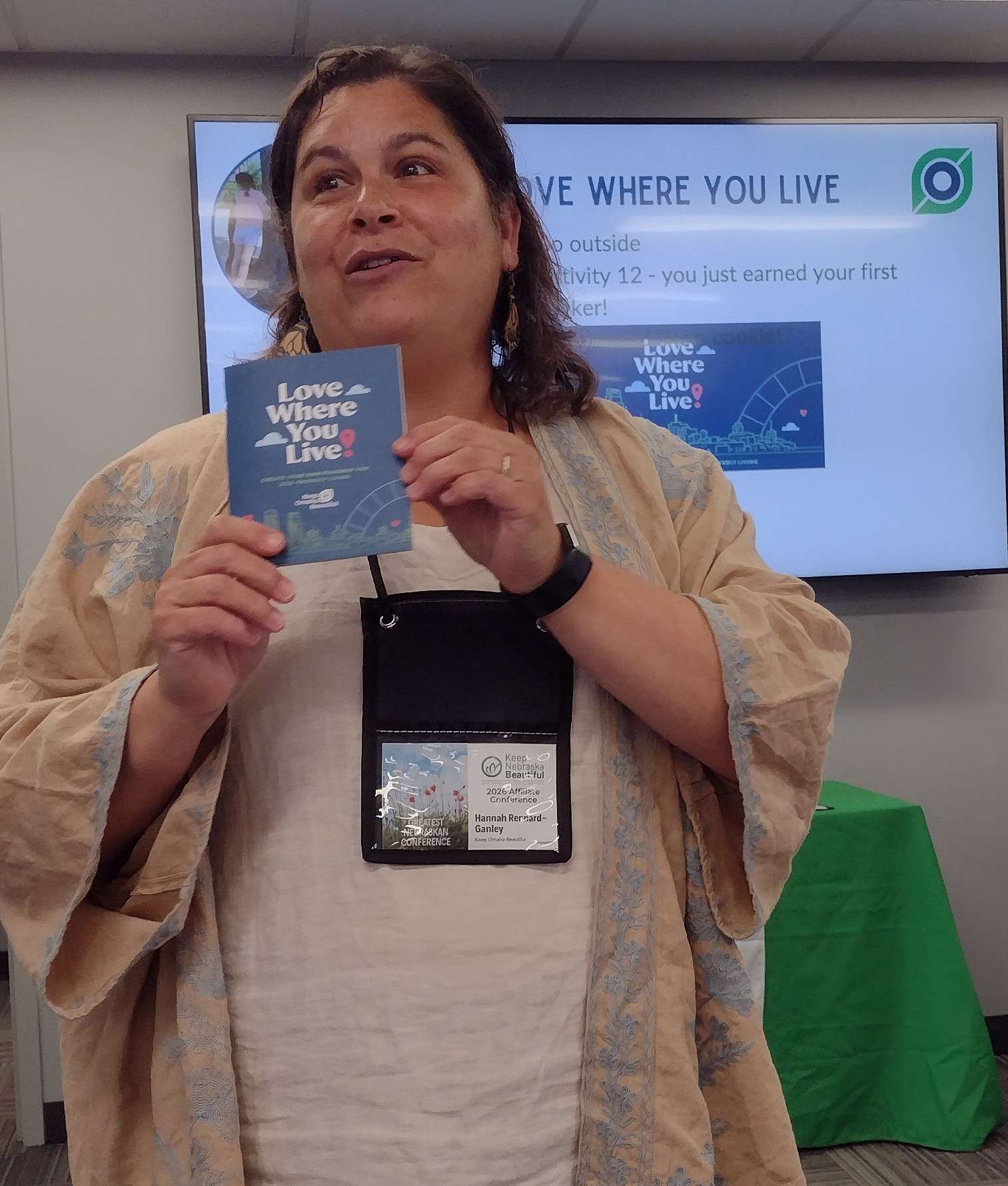
Sandwiched between litter study information and legislative discussion led by a pair of state senators was Hannah Rennard-Ganley. The director of education and outreach for Keep Omaha Beautiful (KOB) presented Cultivating Care: Mindfulness Activities that Foster Environmental Awareness.
Though she covered a multitude of activities and programs within the affiliate, much of what Hannah described pertained to KOB’s presence in area schools. When asked whether their environmental education training for teachers is mandatory, specifically what is their “buyin”, the answer was that it depends. Keep Omaha Beautiful coordinates with ESU 3 to offer this type of continuing education, which may be required by certain schools such as Westside and optional at others. “Once they see the benefit they buy in more,” Hannah said.
Training is for K-12 with half offered for early childhood (up to third grade). “If I can get that teacher to implement that in their classroom it has a bigger impact. Third through fifth grade is the sweet spot,” Hannah explained. Regarding the curriculum, KOB checks out six unique kits, including Tremendous Trees and Waste Nothing, Recycle Right. Another kit teaches about the difference between an ecosystem and a habitat with strong STEM components. KNB President Bob Verkuilen read our minds when he asked if the kits could be transferred to other affiliates.
Hannah replied that they could be picked up if anyone wanted to drive to Omaha. For those of us in another time zone or even a few hours away she offered to share PDF’s.
Working from a kit or bringing another environmental activity can be a challenge if there is no corresponding curriculum in place. “I love environmental science because it's cross curricular . . . For a lot of schools that science journal is a language arts journal . . . because that’s how we’re able to get it done,” Hannah said.
Demand is so strong for KOB’s programming that they cannot supply every request. Hannah is working to mine data to gauge the impact of their efforts. “We’re trying to put into grants to access OPS (Omaha Public Schools),” she said, noting every activity they have is held to (educational) standards.
To conclude the session the plan had been to go outside for a nature activity. Construction below meant additional time in the air conditioning with engaged imaginations, such as thinking about a favorite species during tree yoga. Hannah showed everyone a booklet from KOB. “Love Where You Live! Create your own roadmap for eco-friendly living” features 12 activities that relate to the charge inside the cover: You can do something great for the environment, starting right where you are! Living sustainably is a journey, and every step you take makes a difference. We were slated to “Soak in the scenery”, activity 12, which promotes mindfulness. I hope everyone that attended the conference will be able to complete the activity, which starts with finding a “comfortable spot to sit, such as under a tree or in a garden.”
Hannah concluded by relating the long-term benefits of simply getting youth outside within the scope of overall environmental education and inclusion. She keyed in on an “insane loneliness” stoked by an average 10-12 hours of recreational screentime for middle schoolers. Upon entering high school she noted this falls to about six hours as students find jobs. She said, “Society says you’re supposed to stay inside. . . . If you take them outside, kids will naturally want to take care of it. Studies have found when you are exposed to nature before age 9 you are more likely to have a career taking care of it.”