


By Aaron Berger, Nebraska Extension Livestock Educator
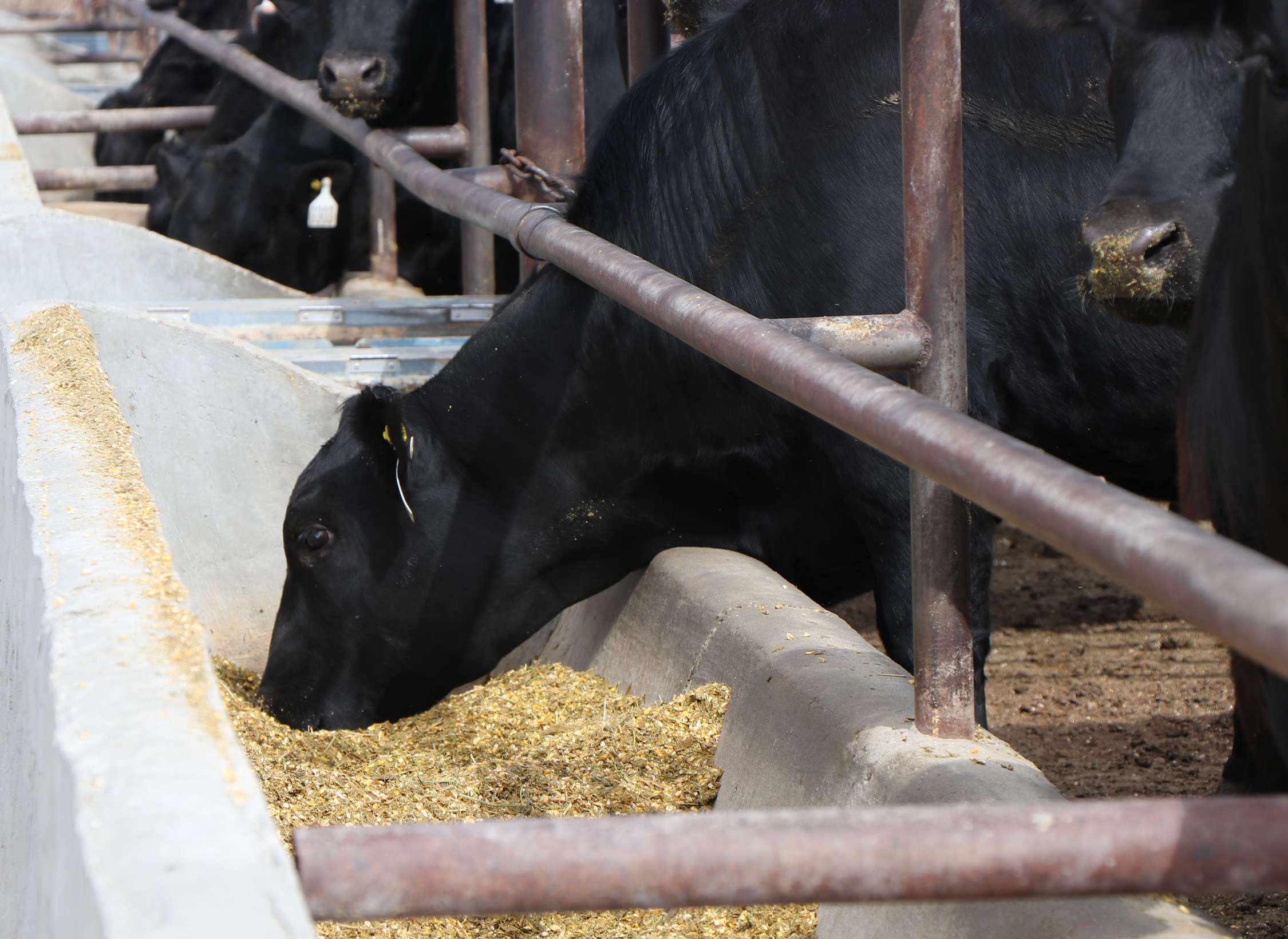
Drought conditions are challenging producers to be creative as they consider options for maintaining the cowherd through the summer, given limited pasture availability. Several research studies conducted at the University of Nebraska have shown that cows can be managed effectively utilizing a limit-fed ration.
In a limit-fed ration, the nutrient requirements of cattle are met with a diet that is less than the actual total amount that the cattle would eat if they had full access to all they could. Typically, these are total mixed rations, fed with a feed truck or wagon, consisting of limited amounts of forage and combined with protein and energy dense feed resources such as distillers grains.
For producers without access to a feed wagon, limit feeding can still be an option. Research at the University of Illinois and the University of Minnesota showed that cows can be given timed access to hay bales in feeders, with 3 hours of access, consuming 17 lbs. of dry matter of hay per day, while cows with 24-hour access consumed 34 lbs. of hay per day on a dry matter basis. Total hay waste was reduced significantly in both research studies when cows were limited to 14 hours or less on the bale feeders.
The type of bale feeder can also significantly impact the amount of hay waste. Research conducted by Oklahoma State University examined four bale feeder designs: a conventional open-bottom steel ring, a sheeted-bottom steel ring, a polyethylene pipe ring and a modified cone feeder with a sheeted bottom. Hay waste was the lowest for the cone feeder at 5.3 percent, followed by the sheeted-bottom feeder, polyethylene feeder and the open-bottom steel ring feeder. The combination of timed access to hay and use of bale ring feeders that reduce hay waste can stretch limited hay supplies.
When the availability of hay is limited by both quantity and quality, the feeding of grain and co-products in a bunk can be utilized to provide the additional protein and energy needed to meet a cow’s nutrient needs.
A research study conducted at Ohio State University found that mature cows could be fed a limit-fed corn diet in place of hay during late gestation and early lactation. Cows were either fed around 11 pounds of whole shelled corn, 2.5 pounds of a pelleted supplement and 2 pounds of hay (dry matter basis) or offered hay and a free choice salt and mineral from November to April. Hay offered free choice was predominantly first-cutting orchard grass, testing around 72 percent neutral detergent fiber (NDF) and 9.5 percent crude protein (CP). Cows in this study fed free-choice hay ate twice as much feed as the limit-fed diet. Cows on the limit-fed corn-based diet experienced no detrimental effects on subsequent performance, conception rates or on calf weaning weight when the limit-fed period was followed by summer grazing on pasture.
Producers should consider the following management practices when utilizing limit feeding.
- Work with Nebraska Extension Beef Educators and Specialists to develop a ration that will meet protein and energy requirements. The ration will need to be adjusted throughout the feeding period to meet the nutritional needs of both the cow and calf.
- Give at least 30 inches of bunk space per cow when limit feeding an energy and protein dense diet. If bunk space is limited, consider doubling the use of bunks by sorting cows into two groups. Feed one group of cows in the morning and the other group later in the day.
- Provide creep access to hay and supplements to ensure calves receive adequate protein and energy to meet their nutritional needs. Plus, a separate watering tank that is set up just for calves can be beneficial.
- Utilize a vitamin and mineral supplement that complements feeds being utilized. Cows with limited access to hay are prone to consume more free choice mineral than needed.
- Consider using the ionophore monensin to improve feed efficiency.
- Divide cows into groups based on age and pecking order to ensure all cows receive their fair share of feed. Monitor cows' body condition scores and adjust groups as needed to ensure thin and timid cows have access to the feed they need.
- Cows will often act hungry when receiving a limit-fed diet, even though the ration is meeting the cow’s nutrition requirements. Feeding cows at consistent times each day will help reduce discontented behavior.
Limiting cow feeding in a dry lot can be accomplished without feeding a total mixed ration. With some creativity and planning, producers can often use existing equipment and resources in a way to limit feed and meet cow nutrition needs without the use of a feed truck or wagon.
For more information on Drylotting Beef Cows - A Drought Management Strategy.